Your ecommerce platform shapes how fast you launch, how well you scale, and how much it costs to grow. Shopify, BigCommerce, and custom-built platforms each offer different strengths depending on your needs.
The short answer:
Shopify is fast and user-friendly, ideal for small-to-medium brands needing quick setups and managed infrastructure.
BigCommerce is great for mid-sized brands, especially those with B2B or wholesale needs, thanks to its built-in tools and no transaction fees.
Custom platforms are for large enterprises with unique technical needs and the budget to support them.
What you'll learn:
This guide breaks down the pros, costs, and use cases of each platform. By the end, you'll know which option makes the most sense for your revenue, goals, and team.
Let’s dive in.
Key Factors When Choosing an Ecommerce Platform
Picking the right ecommerce platform comes down to a few key things: scalability, cost, ease of use, customization, and integration. These factors shape how quickly you can launch, how much you'll spend monthly, and whether your team spends time selling or fixing tech problems.
Scalability and Performance
Shopify and BigCommerce both handle scaling for you. No need to worry about servers or load balancers when traffic spikes. Shopify, for example, managed over $9.3 billion in sales during the 2025 Black Friday Cyber Monday period with 99.99% uptime. Shopify stores also load 1.4× faster on average, with 93% meeting Google's Core Web Vitals benchmark compared to 80% for BigCommerce [2][4].
Custom-built platforms give you more control over scalability, but you're on the hook for managing it - things like configuring auto-scaling groups, database replication, and caching layers. While you can tailor everything, it can also lead to technical debt and a fragile site.
If you're planning for flash sales or rapid growth, auto-scaling is critical. Skullcandy’s switch from BigCommerce to Shopify in 2025 cut their product launch time from 1.5 days to just 30 minutes, showing how a platform built for scale makes a difference [4].
But performance isn't the only factor - cost is just as important.
Cost and Pricing Structures
Shopify offers a lower total cost of ownership (TCO) on average - 33% less than competitors [6]. BigCommerce, on the other hand, averages 45% higher TCO than Shopify over five years, largely due to higher implementation costs (88% more) [6][4]. Custom platforms are the most expensive, with build costs ranging from $20,000 to $500,000+ and annual maintenance between $30,000 and $300,000+ [2].
Transaction fees vary too. Shopify charges 0.5%–2% unless you use Shopify Payments, while BigCommerce charges none [1][7]. However, BigCommerce has annual sales thresholds that can push you into higher-priced tiers - something to consider if you're growing quickly.
For example, Rainbow Shops slashed platform fees by 80% after moving from Salesforce Commerce Cloud to Shopify in 2024, shifting to a predictable monthly fee model. Similarly, BPI Sport saved $4,000 a month in development costs after leaving BigCommerce, where they were spending over $6,000 monthly on tech fixes [6][4].
Ease of Use for Business Owners
How easy a platform is to use can make or break your ability to adapt and grow. Shopify is known for quick setups, often taking just days or weeks. BigCommerce typically takes longer - weeks to months - but comes with more built-in features, which can reduce reliance on apps. Custom platforms are the slowest, with launches taking anywhere from 3 to 12 months [2].
Consider Filtrous, which spent a year trying to launch a custom BigCommerce site, only to face constant issues with updates. They switched to Shopify B2B in 2025 and launched a fully integrated site in just 63 days [4]. This highlights the difference between a managed SaaS platform and the challenges of self-managed infrastructure.
Customization and Flexibility
When it comes to customization, Shopify’s checkout process is mostly locked unless you're on the Plus plan, which starts at $2,000 per month [5]. BigCommerce and custom platforms, however, offer more control over checkout settings and URL structures. Custom platforms provide unlimited flexibility, but that means you're also responsible for maintaining every part of the code.
Platforms like Shopify and BigCommerce handle updates and security patches automatically. Custom solutions require you to manage these manually, including costly PCI compliance audits that can range from $15,000 to $50,000 annually for Level 1 certification [2].
Integration with Tools and Systems
A platform’s ability to integrate with tools can streamline operations and fuel growth. Shopify has an ecosystem of over 8,000 apps, while BigCommerce offers around 1,500 apps and more enterprise-grade features built in [1][4]. Custom platforms require manual integration for every tool - whether it’s for marketing, analytics, or inventory management - adding ongoing developer costs.
Take Lull, a mattress retailer that moved to Shopify in November 2023. By implementing Shop Pay, they saw a 14% boost in conversions during Black Friday Cyber Monday, with 80% of express checkouts coming through Shop Pay [4]. This shows the advantage of a mature app ecosystem where integrations work right out of the box.
Factor | Shopify | BigCommerce | Custom Build |
|---|---|---|---|
Auto-Scaling | Yes | Yes | Manual configuration required |
Uptime SLA | 99.99% | 99.99% | Negotiated with provider |
Transaction Fees | 0.5%–2% (unless Shopify Payments) | 0% | 0% |
App Ecosystem | 8,000+ apps | 1,500+ apps | Manual integrations |
Time to Launch | Days to weeks | Weeks to months | 3–12 months |
Annual Maintenance | Included in SaaS | Included in SaaS | $30,000–$300,000+ |
Shopify: Strengths and Limitations

Shopify powers over 4.6 million stores worldwide and handles more than $235 billion in annual GMV [2]. You can launch a basic store in as little as 48 hours [5][8], and the platform takes care of hosting, security patches, and server maintenance, boasting 99.99% uptime [1][2]. During the 2025 Black Friday Cyber Monday period, Shopify processed over $9.3 billion in sales [2].
But Shopify isn't without its challenges. For example, the checkout page is locked for standard plans, and unlocking deeper customization requires a Shopify Plus subscription, which starts at $2,300 per month [3][5]. Its rigid URL structure (e.g., /products/ and /collections/) can't be modified, which may demand a comprehensive redirect strategy during migrations [1][5]. Additionally, while Shopify's app ecosystem is massive - with over 8,000 apps compared to BigCommerce's 1,300 - features that come standard on other platforms often require paid apps here [1][2].
Beginner-Friendly Interface
Shopify's design makes it approachable for non-technical users. Take Dawn LaFontaine, founder of Cat in the Box, as an example. She built her cat-focused cardboard playhouse business in just hours, despite lacking technical expertise. For her, the ease of setup and quality telephone support made Shopify the clear choice over platforms like WooCommerce or Wix [11].
With tools like the drag-and-drop editor and AI-powered features such as Shopify Magic and the AI Website Builder, you can automate tasks like writing product descriptions and designing store layouts. This means less time spent troubleshooting and more time focusing on sales [10][11].
App Ecosystem and Extensions
Shopify’s app store is one of its greatest strengths, offering over 8,000 apps to expand functionality. Whether it’s loyalty programs, subscriptions, or advanced product reviews, you can add features without hiring a developer [12][4]. However, this flexibility comes with a price. Enterprise stores often spend between $500 and $1,500 or more per month on app subscriptions [3][1]. While apps can speed up deployment and add functionality, they can also increase costs and create performance issues if not managed carefully.
Transaction Fees and Payment Gateways
Shopify doesn’t charge transaction fees if you use Shopify Payments. But if you opt for third-party gateways like PayPal or Stripe, fees range from 0.5% to 2%, depending on your plan [1][10]. For example, a store generating $1 million annually could face $30,000 to $50,000 in fees [5]. In contrast, BigCommerce doesn’t charge transaction fees regardless of the payment processor [1][3]. To minimize costs, stick with Shopify Payments when possible - it simplifies setup and avoids the need to configure additional gateways.
Scalability with Shopify Plus
Shopify Plus is built for high-volume brands, handling over 80,000 checkouts per minute during peak events [3]. Over 30,000 stores currently use Shopify Plus [11]. Pricing starts at $2,300 per month for a three-year term or $2,500 per month for a one-year term. Once your monthly revenue exceeds $800,000, Shopify Plus switches to a revenue-based model of 0.25% of sales, capped at $40,000 [3].
Brands like Skullcandy have seen real benefits with Shopify Plus. After migrating, they reduced product launch times from 1.5 days to just 30 minutes. Evin Catlett, Skullcandy’s Vice President of Global Ecommerce and Growth Marketing, noted:
"Shopify Plus has really become a unicorn. We've found it's very easy to add on, and it integrates with every single relevant platform, which is incredible." [4]
Shopify Plus also enables checkout customization through "Checkout Extensibility", allowing brands to use UI extensions and Shopify Functions for safer, more efficient modifications - something not available on lower-tier plans.
Why It Matters: Shopify stands out for its speed and simplicity. You can launch quickly, scale predictably, and skip the hassle of managing infrastructure. However, these perks come with trade-offs like locked checkout options on lower-tier plans, transaction fees for third-party gateways, and reliance on apps that can increase costs. For brands focused on ease of use and fast market entry, Shopify delivers. But for those needing deep customization or aiming to avoid extra fees, these limitations could be deal-breakers.
BigCommerce: Features for Growing Brands
For brands looking to expand, having a platform that balances solid performance with predictable costs is a must. BigCommerce delivers on both fronts with built-in features and seamless integration.
Since 2016, BigCommerce has achieved 100% uptime during Cyber Week every year [15]. Unlike Shopify, which relies heavily on apps, BigCommerce includes key features natively. From product filtering and customer groups to multi-channel syncing, it avoids what Danielle from Duck Soup E-Commerce calls:
duct-taping your store together with plugins [13].
BigCommerce supports up to 600 SKUs per product [14] and integrates with over 130 payment gateways without taking a cut [16]. This approach reduces the need for extra plugins and subscription costs, making it a practical choice for growing brands.
Built-In Features
BigCommerce comes loaded with tools designed to simplify store management. Features like Faceted Search, included in Pro plans, let customers filter products by size, color, or price [13]. Abandoned cart recovery is standard in Plus plans [14], while multi-storefront management allows you to operate multiple stores - retail, wholesale, or regional - from one backend [13]. Advanced SEO tools, such as customizable URLs and automatic 301 redirects, come ready to use [14]. As Krunal Vaghasiya, Founder of WiserReview, puts it:
BigCommerce is built for brands that plan to grow, with no product limits and stronger built-in features [14].
No Transaction Fees
BigCommerce stands out by charging 0% transaction fees on all plans, no matter which payment processor you choose [13]. This makes it easier to budget for multi-channel operations and eliminates surprises as your sales grow.
Multi-Channel Selling Made Easy
BigCommerce integrates directly with platforms like Amazon, eBay, Walmart, Instagram, and Google Shopping [17]. A centralized dashboard syncs inventory across all channels, cutting down on manual updates. UntilGone, a daily deals marketplace, switched from Shopify Plus to BigCommerce to bypass Shopify’s API rate limits. After migrating, they saw a 200% jump in email-driven revenue. Richard Bell, President of UntilGone, shared:
Shopify architects their platform so you use only their products. Because of this, Shopify became more and more limiting for us, specifically with their API rate limits [16].
B2B and Enterprise Tools
BigCommerce also shines in the B2B space, offering tools tailored for enterprise needs. Designerie, a hybrid B2B/B2C furniture importer, moved to BigCommerce for its built-in wholesale features. These include customer-specific pricing, custom pricing tiers, quoting tools, invoicing, account hierarchies, and direct quote generation. Brandon McCarthy, Managing Director at Designerie, explained:
When we were comparing Shopify Plus to BigCommerce, it was clear that BigCommerce's B2B wholesale functionality was far superior... You just simply don't find this level of native capabilities on Shopify Plus [16].
Users of BigCommerce's B2B Edition have reported impressive results, including a 391% ROI over three years. With a breakeven point in just eight months and a 211% ROI by year three, it offers a lower total cost of ownership compared to other platforms [15].
Why It Matters: BigCommerce eliminates extra costs from transaction fees and third-party apps while offering built-in B2B tools that other platforms often charge extra for. For growing brands managing retail and wholesale channels, it provides scalability without piling on subscription fees. However, its steeper learning curve and longer setup times are worth keeping in mind.
Custom-Built Platforms: Maximum Flexibility, Higher Investment
Custom-built platforms are designed specifically for your business needs - whether you're managing a multi-vendor marketplace, running auction-based commerce, or handling configure-to-order systems that off-the-shelf templates just can't accommodate [18][1]. They offer complete architectural freedom, meaning no platform restrictions and no extra transaction fees beyond what your payment processor charges [19][8].
But this level of flexibility comes at a price. Custom builds typically range from $40,000 to over $250,000, depending on complexity, and take 6 to 12 months to launch [18]. Compare that to the 1–3 months it takes to set up a SaaS platform, and the difference is clear. However, for businesses generating over $30,000/month in revenue, the investment can make sense. For instance, a company earning $50,000/month could save around $12,500 over three years by avoiding transaction fees and app subscriptions [19].
Complete Customization
With a custom platform, you own your code and data outright. That means no platform lock-in and no risk of sudden price hikes [19]. You can optimize for ultra-fast load times and achieve Lighthouse scores of 90+, something that's tough to do on shared SaaS platforms [18][19]. This kind of control is a game-changer for businesses requiring deep integrations with legacy ERPs, custom CRMs, or warehouse management systems that don’t work well with standard APIs [1][19].
While platforms like BigCommerce offer advanced B2B features, custom builds let you go even further. You can create tiered pricing, custom quote workflows, and account hierarchies tailored to your needs - features SaaS platforms simply can't replicate [18][19]. If your business operates in a niche like Etsy-style marketplaces or highly regulated industries such as fintech or healthcare, custom development may be your only viable option.
High Initial and Maintenance Costs
The freedom of customization comes with a hefty price tag, both upfront and ongoing.
Beyond the initial investment, annual maintenance costs typically run 15–20% of the build cost [18]. For a $100,000 platform, that’s $15,000 to $20,000 per year, not counting new feature development. Monthly maintenance can range from $1,000 to $5,000, while feature updates may add another $2,000 to $10,000 [18].
Shreyas Manolkar, Founder of Conception Labs, highlights the risk of overbuilding:
Building your own search engine to save $300/month in SaaS fees is a $30K+ mistake [18].
Hosting costs also add up, ranging from $200 to $2,000 per month, depending on your infrastructure [18]. Unlike Shopify or BigCommerce, where updates and security are handled for you, custom platforms require a dedicated engineering team. Losing a key developer could stall operations if your codebase isn’t well-documented [2][1].
Best for Enterprise Requirements
Custom platforms make the most sense for established enterprises with steady revenue streams. Businesses generating $1M to $5M annually often find them more cost-effective than paying ongoing SaaS platform fees and transaction charges. For example, at $200,000/month in sales, Shopify’s transaction fees alone can reach $1,200 to $4,000 per month [19].
Elliott Davidson, an ecommerce consultant, offers a practical perspective:
The TCO [total cost of ownership] from an open-source platform can be very costly and tends to be more expensive than the SaaS counterpart. You really have to ask yourself if you even need this extra control. In most cases the answer is no [9].
The ideal fit? Businesses with proven demand and workflows that SaaS platforms can’t handle. If you expect to scale beyond $30,000/month within 18 months, starting with a custom build could save you the hassle and expense of migrating later - data and SEO preservation alone can cost $5,500 to $17,000 [19].
Why It Matters: Custom platforms give you unmatched control and eliminate platform fees, but they also require significant upfront investment and ongoing technical resources. For most businesses, custom builds make sense only when revenue consistently exceeds $1M annually. For smaller brands, platforms like BigCommerce or Shopify offer scalable solutions without the burden of maintaining your own infrastructure.
Shopify vs BigCommerce vs Custom: Side-by-Side Comparison
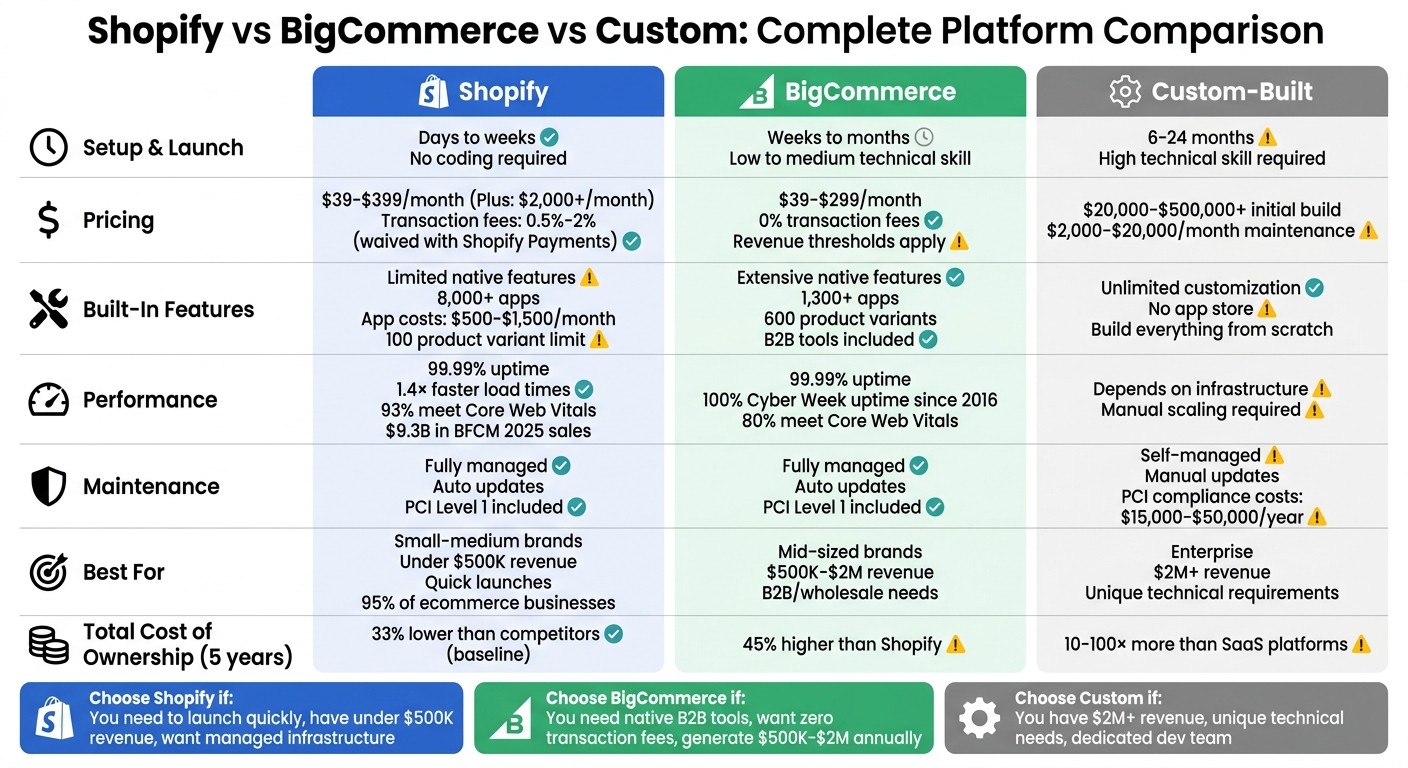
Shopify vs BigCommerce vs Custom Platform Comparison Chart
This breakdown highlights the essentials for growing brands.
Ease of Use and Onboarding
Shopify is designed for simplicity. You can set up a functional store in days or weeks without needing coding skills or worrying about hosting. The platform handles security updates, server management, and patches automatically, so you can focus on selling [2].
BigCommerce also offers a user-friendly interface, though it may feel less intuitive to those without technical experience. Setup can take weeks to months, and while daily operations don’t require constant developer help, there’s a steeper learning curve compared to Shopify [1]. Like Shopify, it manages infrastructure and security for you.
Custom-built platforms, on the other hand, require a skilled development team. Launching a custom site can take anywhere from 6 to 24 months [2]. Making changes or updates often means relying on developers, creating an ongoing dependency.
Feature | Shopify | BigCommerce | Custom-Built |
|---|---|---|---|
Setup Time | Days to weeks | Weeks to months | 6–24 months |
Technical Skill Required | Low (No code) | Low to Medium | High (Developer required) |
Maintenance | Fully Managed | Fully Managed | Requires self-management |
Security | PCI Level 1 included | PCI Level 1 included | Owner's responsibility |
Why It Matters: If speed and simplicity are your priorities, Shopify or BigCommerce can take the technical stress off your plate. Custom platforms only make sense if you have a dedicated team and specific needs that off-the-shelf solutions can’t meet.
Built-In Features vs App Dependency
Shopify leans heavily on its app ecosystem, with over 8,000 apps available [1]. This makes it easy to expand features quickly, but it can result in "app bloat" and monthly costs between $500 and $1,500 for fully equipped stores [20]. However, Shopify has some limitations, like a 100-product variant cap and advanced B2B tools being mostly reserved for Shopify Plus [20].
BigCommerce provides more features right out of the box. This includes tools like faceted search, native B2B capabilities (price lists, customer groups), and multi-currency support [20]. It supports up to 600 product variants and offers fully customizable URLs for better SEO. While its app store is smaller (around 1,300 apps), you’ll likely need fewer third-party integrations [20].
Custom platforms give you total flexibility - there are no limits on features or architecture. But without an app store, every feature must be built from scratch, which requires more time and resources [1][2].
"We now have a testing strategy that allows us to iterate, learn, and improve in a highly agile way... the ecosystem provides the flexibility to make it happen."
Evin Catlett, VP of Global Ecommerce, Skullcandy [4]
Why It Matters: Shopify’s app ecosystem offers versatility and speed, but costs can add up fast. BigCommerce delivers a stronger set of built-in tools, reducing reliance on apps. Custom platforms offer unmatched control but demand heavy investment in development and maintenance.
Pricing and Scalability
Pricing and scalability are critical factors when choosing a platform.
Shopify plans start at $39/month (Basic) and go up to $399/month (Advanced), with Shopify Plus starting at $2,000+/month [1]. Transaction fees of 0.5%–2% apply if you don’t use Shopify Payments [5]. Shopify powers over 4.6 million stores and handled $9.3 billion in sales during the 2025 Black Friday Cyber Monday period with no downtime [2]. On average, Shopify stores are 1.4× faster than BigCommerce sites, with 93% meeting "fast" performance benchmarks compared to 80% for BigCommerce [4].
BigCommerce plans range from $39 (Standard) to $299 (Pro) per month, with no transaction fees [20]. However, revenue thresholds (from $50,000 to $400,000 annually) may require you to upgrade your plan. Over five years, BigCommerce’s total cost of ownership is estimated to be 45% higher than Shopify due to added complexities in implementation and operations [4].
Custom builds come with a hefty price tag. Mid-sized stores can expect to spend $15,000–$80,000, while enterprise solutions can range from $200,000 to $500,000+ [5]. Maintenance costs run $2,000–$20,000 per month [2]. Custom platforms only become cost-effective when annual platform and app fees exceed $15,000–$20,000 - typically when annual revenue hits $800,000 to $1.5 million [5].
In 2023, Lull, a mattress retailer, moved from a custom platform to BigCommerce and saw a 15% drop in checkout conversions. After switching to Shopify and integrating Shop Pay, they experienced a 14% lift in conversions during Black Friday Cyber Monday [4].
Why It Matters: Shopify offers a balance of pricing, performance, and scalability for most brands. BigCommerce eliminates transaction fees but can have higher long-term costs. Custom platforms are viable only for high-revenue businesses with unique needs that SaaS platforms can’t accommodate.
Customization and Maintenance
Your need for customization should be balanced against the effort required for ongoing maintenance.
Shopify limits checkout customization (unless you’re on Shopify Plus) and has fixed URL structures [1]. However, it manages all updates, security patches, and server scaling for you [2].
BigCommerce offers more flexibility with native checkout customization and fully customizable URLs [20]. Like Shopify, it handles all maintenance and security [2].
Custom platforms provide complete control. You own your code and data, but every feature must be developed, tested, and maintained by your team. Security, hosting, and PCI compliance are entirely your responsibility [1][2]. Losing a key developer can disrupt operations significantly.
Why It Matters: Shopify and BigCommerce handle the technical side, freeing you to focus on growth. Custom platforms give you full control but require a long-term commitment to development and upkeep.
Best Fit by Business Size
Small brands (under $500,000 annual revenue): Shopify is ideal for quick launches and validating your business model. Its managed infrastructure and 99.99% uptime ensure reliability during high-traffic events [5][2].
Mid-sized brands ($500,000–$2 million annual revenue): BigCommerce is a strong choice if you need native B2B tools or wholesale features without the high cost of Shopify Plus. Its built-in features and lack of transaction fees can help manage costs [1][20].
Enterprise brands (over $2 million annual revenue): Custom platforms are worth considering if SaaS options don’t meet your needs or if platform fees outweigh the investment in a tailored solution [5].
Which Platform is Right for Your Brand?
The best platform for your business depends on your revenue, team size, and technical requirements.
Shopify: Ideal for Quick Launches and Small-to-Medium Brands
Shopify is the go-to choice for more than 95% of ecommerce businesses [2]. If you're looking to get up and running in days or weeks without a dedicated development team, Shopify takes care of the heavy lifting. Hosting, security updates, PCI compliance, and server scaling are all managed for you [2].
Take CarBahn, for example. In 2025, they transitioned from WooCommerce to Shopify in just 10 weeks. The result? Load times dropped from 9 seconds to 1 second, and organic traffic tripled in just 30 days [6]. Shopify’s app ecosystem, with over 8,000 options, makes it easy to add features as needed. While app costs can range from $50 to $300 per month, this is far less than the $2,000–$20,000 monthly maintenance expenses typical for custom-built platforms [5].
Why It Matters: For small-to-medium brands generating less than $500,000 annually, Shopify offers a managed platform that allows you to scale quickly without the need for a development team.
Next up: BigCommerce, a platform designed for mid-sized brands that need more advanced built-in features.
BigCommerce: Best for Mid-Sized to Large Brands with Advanced Needs
BigCommerce is built for mid-sized to large brands that require advanced tools like B2B functionality, multi-currency support, and wholesale pricing - all without relying heavily on third-party apps [1]. Features like custom price lists, customer groups, and faceted search come included [1].
Another perk? BigCommerce doesn’t charge transaction fees on any plan, which can save you money if you’re not using Shopify Payments [8]. For instance, in 2025, Inhaven launched on BigCommerce in just three to four months, relying mainly on the platform’s native tools rather than third-party apps [8]. However, the platform's complexity can lead to higher implementation and operational costs [6]. Filtrous, a laboratory supply company, experienced this firsthand. They spent a year trying to launch on BigCommerce before switching to Shopify, which enabled a fully integrated B2B site in just 63 days [4].
Why It Matters: BigCommerce is a strong fit for brands with annual revenues between $500,000 and $2 million that need robust B2B or wholesale features. Just be prepared for a steeper learning curve and higher long-term costs compared to Shopify.
For businesses with highly specific technical requirements, a custom platform might be the answer.
Custom Platforms: Tailored Solutions for High-Growth Enterprises
If your business has unique technical needs that no off-the-shelf platform can meet, a custom platform might be worth considering [2]. This option is ideal for enterprises requiring bespoke solutions like complex ERP integrations, proprietary inventory systems, or specialized workflows. Custom builds offer unmatched flexibility and eliminate vendor lock-in [2].
But this flexibility comes at a cost. Initial builds can range from $20,000 to over $500,000, with ongoing maintenance costs between $2,000 and $20,000 per month [2]. You’ll also need a dedicated development team to handle security, hosting, and compliance - tasks that Shopify and BigCommerce manage for you. Custom platforms only become cost-effective when your annual platform and app fees exceed $15,000–$20,000, which typically happens when your revenue hits $800,000 to $1.5 million [5].
Why It Matters: Custom platforms are best suited for enterprise brands generating over $2 million annually. If you’re not at this scale, the costs can quickly outweigh the benefits, draining resources that could be better spent on marketing and growth.
Conclusion
Picking the right ecommerce platform depends on two key factors: your revenue and your technical resources.
Shopify works for most ecommerce businesses[2]. If you’re looking for a quick setup without the need for a development team, Shopify covers everything - hosting, security, PCI compliance, and scaling. During BFCM 2025, Shopify handled $9.3 billion in sales with 99.99% uptime and typically delivers 12% higher checkout conversion rates compared to BigCommerce[2][4].
BigCommerce is ideal for mid-sized brands that need built-in B2B tools, multi-currency support, and wholesale pricing options. While it avoids transaction fees, its long-term costs can add up[1][4]. For example, Filtrous spent an entire year trying to launch on BigCommerce but shifted to Shopify and went live in just 63 days[4].
Custom platforms are best for enterprises with specific needs that can’t be met by standard solutions. However, the costs are steep. Initial builds can range from $20,000 to over $500,000[2], with ongoing maintenance running $2,000 to $20,000 per month[2]. Custom platforms often cost 10 to 100 times more to build and maintain than SaaS options[2]. Without a dedicated development team, this route can limit growth instead of supporting it.
When you factor in the total cost of ownership (TCO), the choice becomes clearer. BigCommerce’s TCO is estimated to be 45% higher than Shopify’s over five years, considering both implementation and operational costs[4].
FAQs
When should I move from Shopify or BigCommerce to a custom build?
If Shopify or BigCommerce feels like it's holding your business back, it might be time to think about a custom-built platform. This option shines when you need advanced customization, room to scale, or specialized features that standard SaaS platforms just can't deliver. Yes, custom builds come with higher costs and ongoing upkeep, but they give you the freedom to tackle complex challenges and support major growth without limits.
What costs should I budget for beyond the monthly plan price?
When considering costs beyond the monthly plan, don’t forget about hosting (if it’s not included), regular maintenance, security measures like SSL certificates, and any custom development or integrations you might need. For custom-built platforms, initial setup costs can start at $20,000 and go all the way up to $500,000, with monthly upkeep ranging between $2,000 and $20,000 or more. Additional expenses might include premium themes, apps, marketing efforts, payment processing, and transaction fees. Thinking ahead will help ensure your budget can handle both current needs and future growth.
How can I avoid SEO losses when migrating platforms?
To keep your SEO intact during a platform migration, stick to these steps:
Run an SEO audit: Record your current rankings, backlinks, and top-performing pages. This gives you a clear baseline to work from.
Set up 301 redirects: Map old URLs to their new counterparts to preserve link equity and avoid broken links.
Plan every detail: Make sure all content, settings, and data are transferred correctly. Missing something can hurt your rankings.
Keep an eye on performance: After the migration, monitor your SEO metrics closely so you can fix any problems fast.